

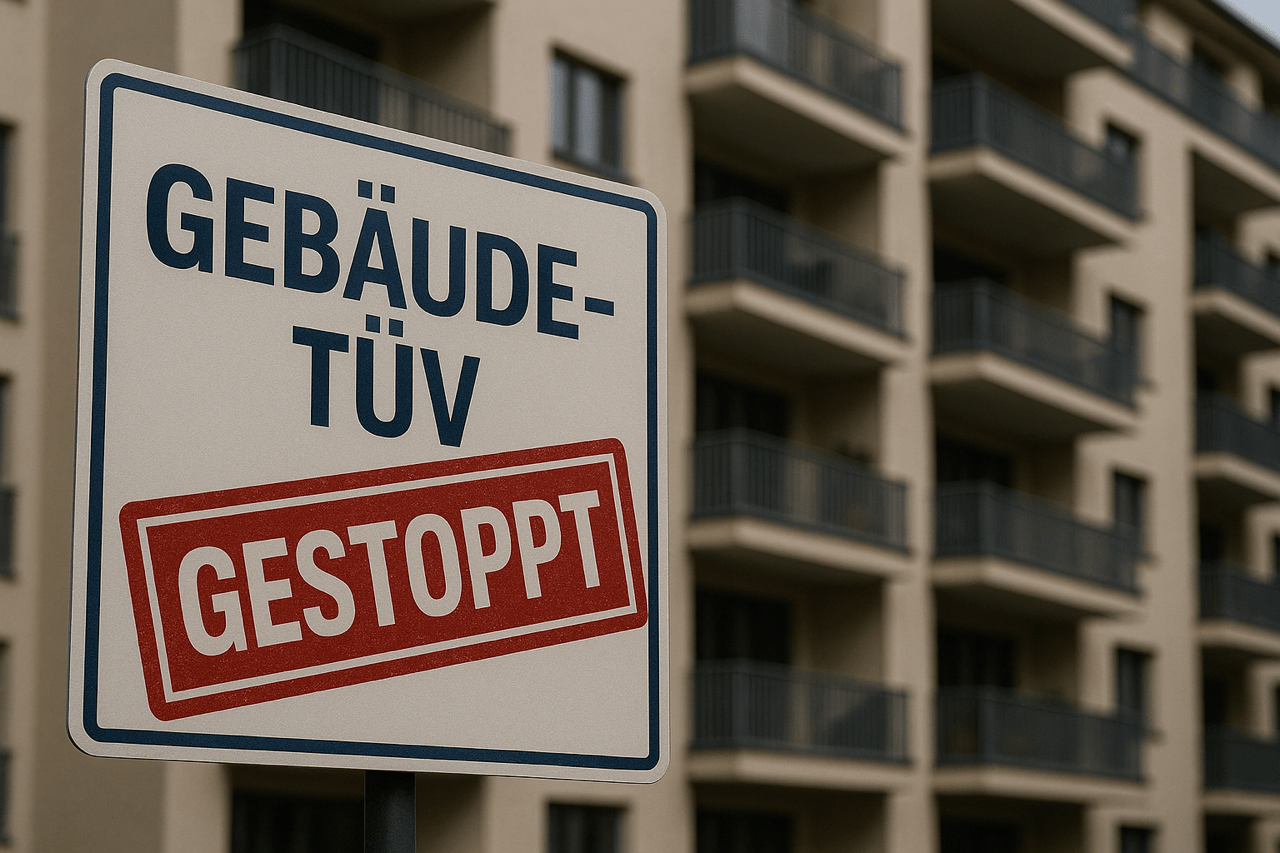
A sigh of relief goes through the real estate industry: the much-discussed “building MOT” for residential buildings will not be introduced. What was originally intended to be a mandatory standard inspection of the energy efficiency and building fabric of all existing properties has failed for the time being following widespread criticism. For private owners, condominium owners’ associations (WEGs) and landlords in particular, this is a noticeable relief – both financially and organizationally.
What was planned?
As part of the implementation of the European Buildings Directive (EPBD), the Federal Ministry for Economic Affairs and Energy introduced a mandatory “building MOT”. The plan was to regularly inspect residential buildings with regard to energy efficiency, technical systems and structural defects. Similar to vehicles, the MOT was to be carried out for fixed periods of time – with corresponding inspection and refurbishment obligations.
Why the resistance was so great
Industry associations, owner representatives and many political players criticized the plans early and clearly. The accusation: overregulation, additional bureaucracy and immense costs – especially for private owners who are already struggling with increasing refurbishment requirements, interest rates and ongoing operating costs. The impending obligation to carry out expensive refurbishment measures would also have been economically disproportionate in many cases.
Another problem was the lack of clarity in the practical implementation: Who should check? How often? And what happens in the event of a “fail”? There were no concrete answers – which added to the uncertainty.
Political signal: reducing bureaucracy instead of a burden
The decision not to pursue the building MOT is also a political signal. At a time when affordable housing and the preservation of existing buildings have top priority, it is clear that climate protection in the building sector needs support and incentives – not an additional burden of inspection obligations that would have led to massive investments, especially in older buildings.
Instead, voluntary measures, funding programs and individual renovation roadmaps are once again becoming more of a focus. A holistic, practical approach should make the decarbonization of the building stock socially acceptable.
What owners should know now
Despite the abolition of the building MOT, the goal of a climate-neutral building stock by 2045 remains. Subsidies, such as the Federal Subsidy for Efficient Buildings (BEG), energy consulting and renovation roadmaps, remain important instruments for owners who want or need to invest in their property.
Even without a legal obligation, it makes sense to regularly assess the condition of the building – not least to make it possible to plan modernizations and secure potential subsidies.
Recommendation: FOCUS Immobilien GmbH
FOCUS Immobilien GmbH supports owners, investors and property management companies in making their properties economically viable and future-proof. Whether it’s developing an individual refurbishment plan, finding energy consultants or selecting sensible modernization measures – FOCUS is at your side with market knowledge, strategic know-how and practical advice.
Even without a mandatory building MOT, anyone who wants to maintain their property in the long term and increase its value will benefit from forward-looking planning. FOCUS accompanies you on this path – competently, independently and solution-oriented.