

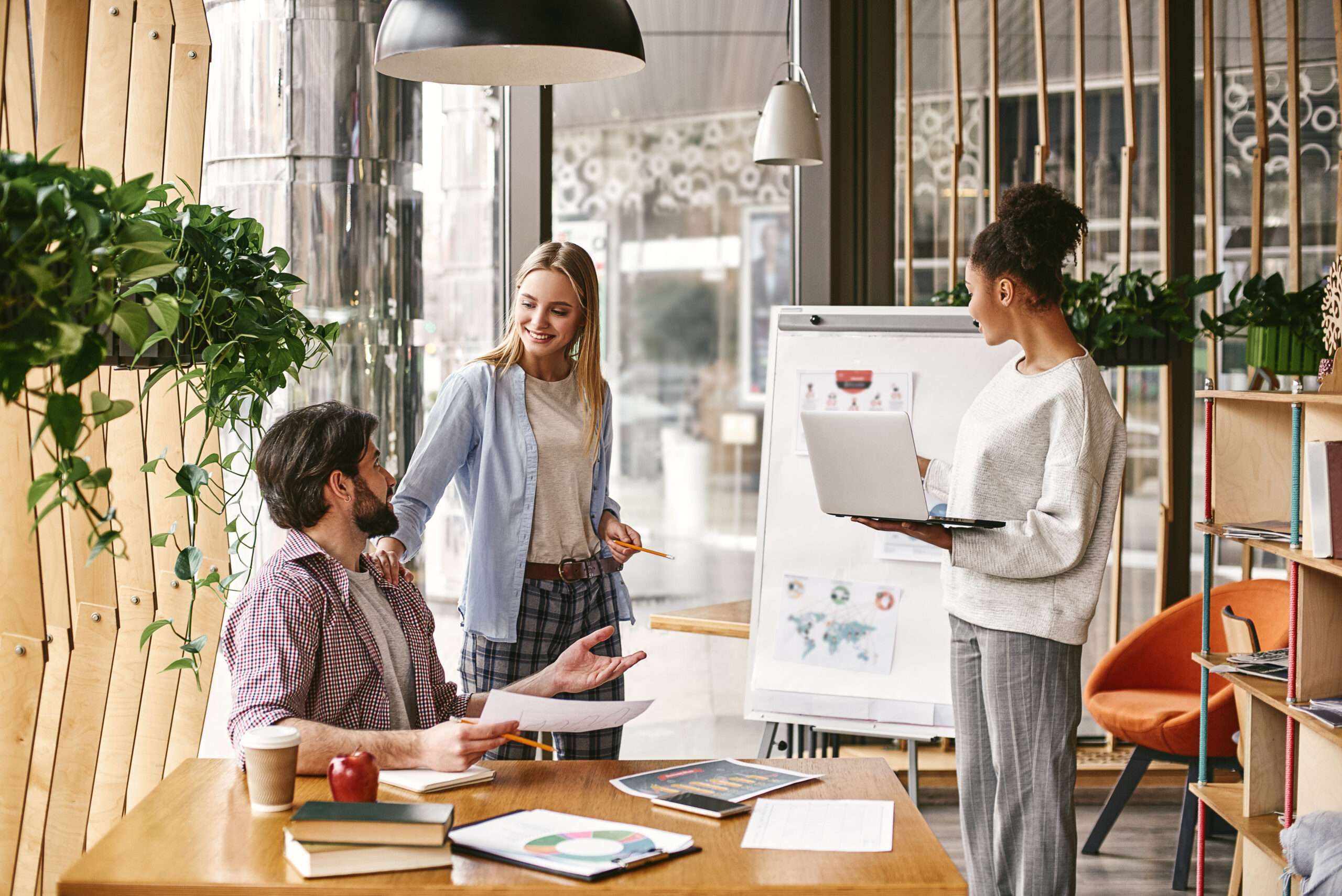
In recent years, our idea of everyday working life has changed fundamentally. Flexible working hours, hybrid teams and creative working environments are no longer exotic concepts – they are part of a new normality that is summarized under the term New Work. But how well are our offices prepared for these changing requirements?
The changing workplace
The pandemic has catapulted many employees into working from home – proving that mobile working can work. At the same time, however, it also became clear that physical spaces are needed for real collaboration, spontaneous ideas and social encounters.
We are also currently seeing a return to a greater presence within the company. Many companies are increasingly calling their employees back to the office – whether in hybrid models or with fixed attendance days. This means that the demands placed on modern working environments continue to rise. People who come to the office today expect more than just a desk – they expect an environment that encourages interaction, offers flexibility and inspires.
What is behind New Work?
New Work stands for more than just working from home or flexitime. It is about a work culture that focuses on self-determination, meaningfulness and collaboration. Originally coined by social philosopher Frithjof Bergmann, the term now describes a comprehensive change in the world of work – influenced by digitalization, globalization and new lifestyles.
Typical characteristics of New Work are
- Work independent of time and place
- Agile team structures instead of rigid hierarchies
- Collaboration instead of competition
- Promoting creativity and innovative spirit
How offices can respond to the new requirements
Modern offices should be more than just a place with desks. They must be geared towards the needs of employees and create spaces that enable different ways of working. The return to physical presence further reinforces this need – because the office must first earn its place again in the new working day.
🔁 Flexibility instead of a one-size-fits-all look
From traditional workstations to retreats – employees need different zones for concentrated work, creative meetings or informal exchanges.
☕ Space for encounters
The corridor radio or conversations in the kitchenette are not a waste of time, but important for social interaction and the corporate culture. Communication zones promote precisely these spontaneous moments.
💡 Encourage creativity
Ideas often arise through dialog. Creative spaces with whiteboards, flexible furnishings and an inspiring atmosphere support teams in developing new concepts.
🌍 Technology & sustainability
New Work does not work without digital infrastructure. Modern conference tools, stable Wi-Fi and smart room concepts are just as essential as sustainable materials and energy concepts.
Office redesign: opportunity instead of duty
Whether through a planned relocation or a renovation – changes to the working environment offer an excellent opportunity to rethink your own corporate culture and implement it spatially. Involving employees at an early stage not only generates valuable ideas, but also acceptance and identification.
Conclusion: more than just a trend
New Work is not a short-lived hype, but an expression of a profound cultural change. Modern offices can support this change – especially now that more presence is required again. Those who manage to design the office as an attractive, flexible and inspiring place will not only boost productivity and innovation, but also the sense of unity within the company.
FOCUS Makler will be happy to support you in making your office space fit for the future – with know-how, market knowledge and an eye for modern working environments.